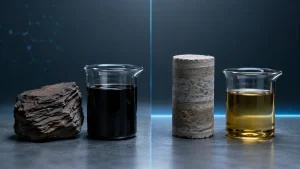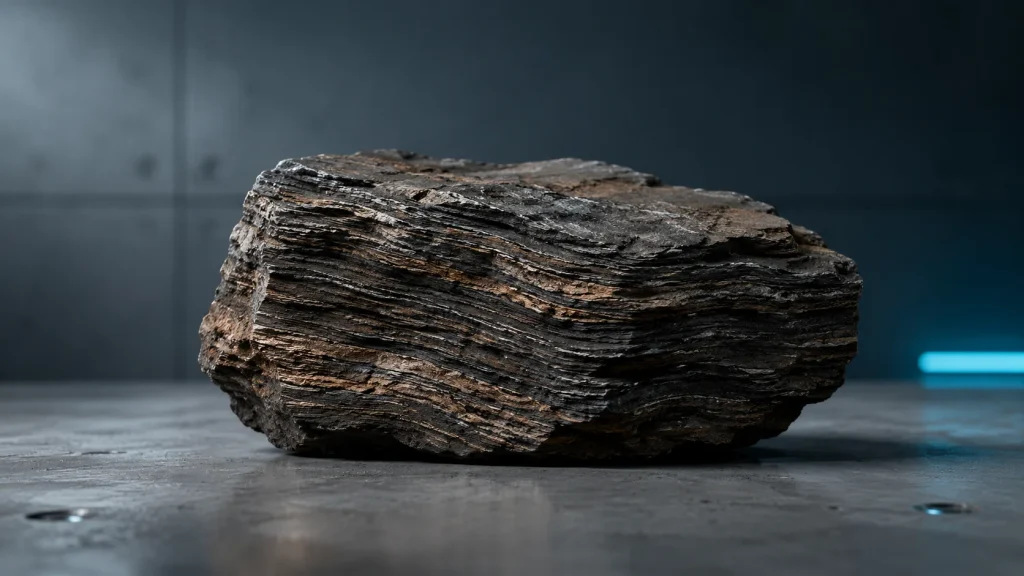
Oil shale is one of the most abundant and underrated forms of solid organic fuel, with global resources that exceed the proven reserves of conventional crude oil many times over. It is a sedimentary rock in which a mineral matrix is intimately interwoven with organic matter — kerogen — which, upon thermal processing, yields liquid and gaseous hydrocarbons. Understanding the origin, composition and properties of oil shale determines the choice of processing technology and the assessment of the industrial value of this feedstock.
What oil shale is
Oil shale is a dense, finely laminated sedimentary rock containing a substantial amount of organic matter that does not dissolve in conventional organic solvents. Its principal combustible component is kerogen — a high-molecular-weight organic substance disseminated throughout the mineral matrix of the rock. Unlike crude oil and natural gas, the organic matter in oil shale exists in a solid state and cannot be recovered by simple extraction; it requires thermal treatment — pyrolysis.
In essence, oil shale occupies an intermediate position between ordinary sedimentary rocks and the caustobioliths of the coal series, representing a distinct type of fuel-energy and chemical feedstock.
Geological origin and formation
Oil shales formed over geological epochs on the bottoms of ancient marine and lacustrine basins through the accumulation and burial of the remains of planktonic algae, microorganisms and other biomass. The predominance of sapropelic organic material, deposited in a reducing, oxygen-deprived environment, distinguishes them from humic coals formed from the remains of higher land plants.
Through diagenesis and subsequent catagenesis, under moderate temperatures and pressure, the original organic matter was transformed into kerogen. The fine interlayering of organic matter with clayey, carbonate or siliceous mineral material gave the rock its characteristic laminated structure and its ash content.
Composition: kerogen and the mineral matrix
Oil shale consists of two principal parts — an organic and a mineral component. The organic part is represented by kerogen, whose share in industrially valuable shales is typically from 10 to 30 % or more by mass; it is kerogen that, upon heating, decomposes to form shale oil, gas and a solid residue — semi-coke. The mineral part accounts for the rock’s high ash content and consists mainly of clay minerals, carbonates and quartz.
The key components of oil shale include:
- kerogen — the principal organic matter and the source of liquid and gaseous products during pyrolysis;
- bitumoids — a small fraction of soluble organic matter;
- the mineral matrix — clays, carbonates (calcite, dolomite), quartz and pyrite, which determine the ash content;
- bound moisture and minor amounts of sulphur and nitrogen compounds.
Physical and chemical properties
The most important technological characteristics of oil shale are its calorific value, ash content, moisture and oil yield, the latter determined by the standard Fischer assay (low-temperature retorting). The calorific value of commercial shales usually lies in the range of roughly 6 to 16 MJ/kg and is considerably lower than that of coal owing to the high proportion of mineral matter. The oil yield in laboratory retorting serves as the principal indicator of a shale’s value as a feedstock for liquid fuel and typically ranges from a few to 20 % or more on a dry-rock basis.
The high ash content and comparatively low calorific value impose limits on the modes of use: direct combustion is less efficient, so for deep processing the thermal decomposition of kerogen, with separate recovery of liquid, gaseous and solid products, is preferable.
Industrial significance and processing
The industrial value of oil shale stems from the fact that during pyrolysis kerogen is converted into shale oil — a synthetic analogue of crude oil suitable for the production of motor fuels, boiler fuel and a wide range of chemical products. This makes oil shale a strategic alternative to conventional oil and gas for regions holding large reserves of it, and the foundation for the development of a shale-processing industry.
The most effective technology for the energy use of shale has proven to be pyrolysis with a solid heat carrier (SHC, Galoter), in which crushed shale is heated by a hot ash heat carrier. This approach delivers a high yield of shale oil, makes it possible to recover the energy of the semi-coke and to use the feedstock comprehensively, while minimising waste generation.