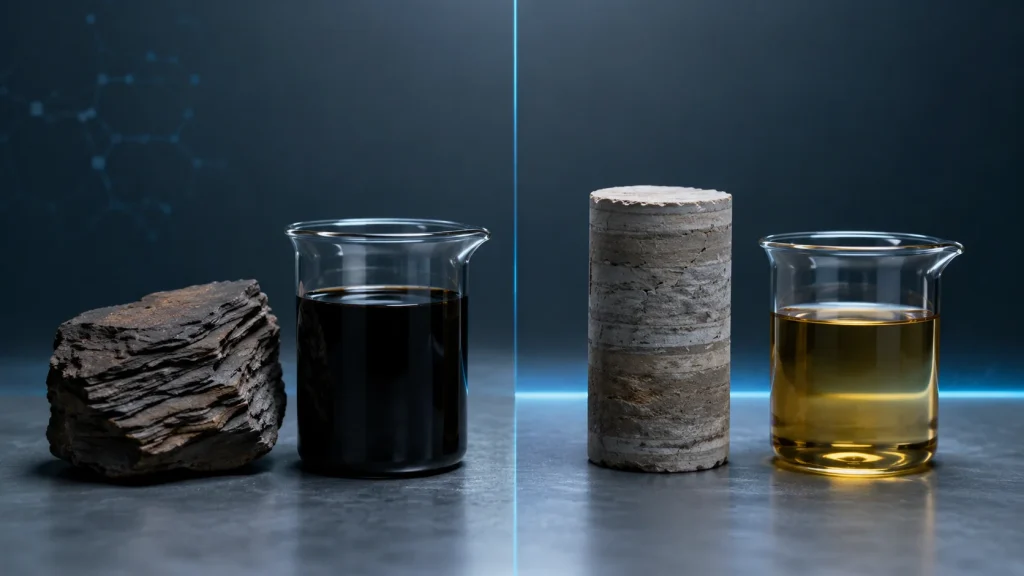
The English term “shale oil” is ambiguous: it is used both for the oil obtained by thermally processing solid oil shale and for the light crude extracted from low-permeability shale formations — two fundamentally different feedstocks produced by entirely different methods. The first is a product of retorting (pyrolysis) of oil shale; the second, properly called tight oil, is recovered by drilling and hydraulic fracturing. Let us examine the source of the confusion, how each is produced, how their composition and quality differ, and where they are used.
Where the confusion comes from
The root of the misunderstanding lies in the phrase “shale oil” itself. Historically it referred to the oil distilled from oil shale; later, with the rise of fracking, the same loose label was applied to light crude produced from shale source rocks. As a result one term came to cover two distinct concepts, and in popular texts the boundary between them is often blurred.
Yet these products correspond to different geological objects and different technologies. To avoid conflating them, engineers distinguish shale oil — the retort (kerogen) oil derived from solid oil shale — from tight oil, extracted from dense rock.
Shale oil: a product of oil shale processing
Shale oil is produced by the thermal processing of oil shale — a sedimentary rock containing insoluble organic matter known as kerogen. The rock itself holds no liquid hydrocarbons: kerogen is converted into oil only when heated in the absence of oxygen (retorting, pyrolysis) at a temperature of about 480–520 °C, when large organic molecules break down and release a vapour-gas mixture that condenses into liquid oil.
In modern solid heat carrier (SHC) units based on the Galoter technology, heat is transferred to the shale by hot ash, which ensures rapid heating and a high oil yield. In essence, shale oil is a synthetic liquid artificially produced from a solid feedstock rather than extracted from the subsurface in ready form.
Tight oil: light crude from dense rock
Tight oil is ordinary light crude that already exists in the subsurface in liquid form but is trapped in dense, low-permeability rock (often shales and tight reservoirs). Because of the extremely low permeability, such oil will not flow to the well on its own, so it is produced by horizontal drilling combined with hydraulic fracturing: fluid with proppant is pumped into the rock under pressure, creating a network of fractures through which the oil flows into the well.
There is no thermal processing of organic matter here — this is the extraction of already-formed crude, simply from a reservoir inaccessible to conventional methods. It is therefore more accurate to call it tight oil rather than a product of shale processing.
Differences in composition and quality
Because the products have different origins, their properties differ as well. Crude shale oil derived from kerogen is usually heavier and contains more heteroatomic compounds — sulphur and especially nitrogen — as well as unsaturated hydrocarbons and resinous components, so it requires upgrading (hydrotreating) before being converted into motor fuels. Tight oil, by contrast, is light and low-viscosity by nature, with a low sulphur content, and is close to high-quality grades of conventional crude.
- Origin: shale oil is synthesised from solid kerogen by heating; tight oil is produced as ready liquid crude from the reservoir.
- Production method: retorting / pyrolysis (SHC, Galoter) versus horizontal drilling and hydraulic fracturing.
- Feedstock quality: shale oil is heavier, richer in nitrogen and resins; tight oil is light and low in sulphur.
- Preparation for processing: shale oil requires upgrading; tight oil can be processed almost like conventional crude.
Where each product is used
Shale oil is a valuable chemical and energy feedstock. Its fractions are used as components of boiler and marine fuel, as raw material for the production of road and roofing bitumen, and for the recovery of individual chemical products; after hydro-upgrading the light fractions can go into motor fuels. The solid heat carrier technology (Galoter, SHC) makes it possible to process oil shale comprehensively, yielding oil, gas and heat.
Tight oil fits into ordinary oil refining on a par with conventional crude: it yields gasoline, diesel fuel, jet kerosene and petrochemical feedstock. Thus shale oil is closer to specialised chemical-technology products, whereas tight oil is a mass-market fuel feedstock on the global market.